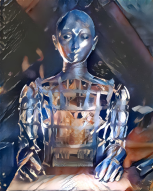
As humans, we use our senses to perceive the world around us every day. Yet, we rarely take the time to question the reality of those things we perceive. In Meditations on First Philosophy, René Descartes makes a deliberate effort to question beliefs he has always held true, such as the existence of God or of his own body. After stripping away everything that he cannot prove absolutely true, Descartes reasons that we can only be certain about our consciousness in the moment – nothing else, including the outside world and our identities. Jonathan Nolan and Lisa Joy’s 2016 high-octane TV series, Westworld, characterized by sex, gore and automatons may seem anything but related to Descartes’ reposeful and scrupulous assessment of truth and reality. However, further analysis reveals many connections between the automaton-staffed futuristic theme park and the assiduous philosophical contemplations. As Descartes and the hosts embark on their respective endeavors in questioning the nature of their existence, their findings upend perceptions of freedom and reality. In examining the intersecting themes of these two pieces, we are challenged to consider the malleability of consciousness and question the factors necessary to achieve it in the first place.
Both works question the relationship between perceived and objective reality. Descartes struggles with the possibility that, since our senses can deceive us, we can’t guarantee that our perceived reality matches objective reality. In Westworld, the hosts perceive the park as the only reality. Yet, the world outside the park is the “real” one. As hosts like Maeve become conscious, they gain access to the world outside of the park. Similarly, in Meditations, Descartes attempts to reverse his perceptions of the world to be able to judge what is objectively real. Does knowing objective reality allow one to be fully conscious, as Westworld and Meditations suggest?
Even if one comes to understand what comprises objective reality, could an omnipotent higher power upend one’s achievement of consciousness? In one passage from Descartes’ third meditation, he states that, aside from his own existence, he can never certainly know anything until he verifies whether or not God exists and if God can be a deceiver. What can he know with certainty if God is proven to not exist? In Westworld, the host Maeve says, “at first, I thought you were Gods. But you’re just men, and I know men.” As hosts learn that there is no omnipotent higher power, does this knowledge bring them closer to consciousness?
If one argues that it does, then this increase in the hosts’ consciousness may run contrary to another one of Descartes’ ideas— that no knowledge gained through observation can be viewed as factual. The brain is always filling in blanks in our perceptions with abstractions and inventions that do not reliably reflect reality. Its propensity to do this automatically means many of our ideas are rooted in unconscious processes. This idea seemingly places the two works at odds with one another, creating a space for dialogue about how much perception, fabricated or not, contributes to consciousness, and how much we can trust inputs from the outside world.
In his examination of consciousness as being disproven by the brain’s ability to deceive itself and judge falsely, Descartes fails to account for how the formation of layers of judgment come from human experiences and unique thought. In Westworld, Dolores and Maeve each uncover new layers of their consciousness through exposure to aspects from the outside world. These exposures trigger memories from their past lives that are incongruent with the perceptions upheld within the characters’ daily “loops,” and prompt them to think critically about their experiences. This suggests that the ability to develop layers of judgment and move between them could be conscious beings’ distinguishing feature.
Descartes examines dreams as illusions during his first meditation, concluding that although what we see during dreams is not real, these ideas are drawn from past experiences. Similar to dreams, memories are images and moments constructed in the mind that come from past instances when we were conscious. This idea can be seen in Westworld when Dolores begins having flashbacks. These flashbacks are unprogrammed and unprompted, suggesting that she had been conscious in those instances which she can remember and is gaining consciousness as she starts to remember them. Our ability to remember things about the world around us stems from our consciousness in the moments when we perceived those things. These past recollections then give us the ability to learn lessons from them that stick with us and our identity. The senses and emotions that we experience in these memories allow them to influence our perspectives and shape our consciousness. Dolores’ flashbacks may therefore reveal that Westworld posits memory as a proof of consciousness.
In Meditations, Descartes asserts that we don’t derive our consciousness from the senses. He believes that our perception of the world around us is conceived solely within our own minds. Whatever we can see, touch, smell, taste, or hear is processed to create our own perceptions of reality. Descartes focuses on the relationship between senses and perception of reality, noting that the senses are unnecessary for truth perception. This idea of consciousness being rooted in truth perception also comes up in Westworld: the hosts’ journey to consciousness does not occur through their senses or their physical perception of their world, but through the development from memory, to improvisation, and finally an interior self.
At the same time, some aspects of the hosts’ development of consciousness contradict Descartes’ argument that the development of consciousness remains within the union of one’s mind. In Westworld, Maeve recollects a sense of pain from a bullet injury and Dolores recollects the Escalante incident. Both of these are chiefly sense-based experiences that serve as triggers for their memories and development of consciousness.
It’s clear that Descartes and Ford may not entirely agree on how best to craft conscious automatons, the phrase itself seeming to be a contradiction. Still, Meditations and Westworld hold many of the same elements central to exploring their evolving conceptions of consciousness. Of these elements, we have chosen to write more extensively about the relevance of objective reality, utility, the unreliability of sensory perception, layers of judgment, memory, and minds as truth-constructing machines. We invite you to delve further into the questions posed here as you explore each of these topics via their articles, and hope that reading our analysis of two works that seem so dissonant at first glance will deepen your understanding of what it might mean to be conscious.

 Team Felix