In using its sensationalized backdrop to posit a question evaluated by the likes of Scarry, Socrates, and Descartes, Westworld invites itself into philosophical discussions and comparisons within academia. I focused my analysis mainly on Descartes, beginning by focusing on a short passage in his writing regarding his judgment of men across the square. I was very focused on his arguments about lack of consciousness due to automatic thought and the invalidity of sensory inputs.
We spend much of our day-to-day lives on autopilot. We wake up and press play on a program that runs us through daily routines and habits, thinking similar thoughts and making decisions in alignment with who we believe ourselves to be. Our realities are somewhat set, and thus a level of abstraction is possible — we can rely on existing systems and ideas rather than coming up with new ones for each scenario that we face. However, the success of these abstractions is entirely reliant on our ability to understand and judge the world around us accurately. If we are wrong about what we see, or think we see, how can these autopilot reactions possibly have the outcomes that we intend?
Descartes comes upon a troubling realization in his Second Meditation that his mind fills in contextual blanks with conclusions that cannot be proven, and as such that it is, in essence, always trying to deceive him. As he sits writing, Descartes thinks that he sees “men crossing the square,” but quickly realizes that this is impossible to confirm, and they could just as easily be “hats and coats which could conceal automatons.” His thoughts are ruled by what is judged to be true rather than objective realities, and it seems no clear path forward exists to ascertain what is certain in the world.
Though this discussion of automatic thought might lead one to argue that Descartes himself is not conscious, the very nature of Meditations shows the opposite. At the outset of his writing, Descartes acknowledges that “some years ago [he] was struck by the large number of falsehoods [he] had accepted as true.” He realizes that he would need to demolish all falsehoods and rebuild his understandings from their foundations if he wants to be certain of any idea he holds. Despite knowing this process to be necessary, Descartes decides to “wait until [he] should reach a mature enough age” before beginning. In this, he admits to allowing for some abstraction within his beliefs until he feels ready to confront them. This demonstrates Descartes’ ability to navigate through layers of judgment and understanding at will, in essence ‘overriding’ his own programming. This is a quality of consciousness known as access: a being has connections in their brain that allow them to choose between a variety of responses. Someone less conscious might’ve had no choice but to demolish their beliefs entirely after realizing they had accepted falsehoods as true, but Descartes was able to wait until he felt like doing so.
This discussion draws us back to earlier concerns about the automatic nature of our daily lives. How might engaging with ideas and practices at different levels introduce consciousness into unconscious routines? Navigating layers of judgement ties closely to the ability to have variation in our ‘automatic’ habits. It is rare that we are operating completely separate/outside of our consciounesses, as each iteration of an action is done with some freshness in context, thought, or feeling.
For example, I started journaling every day at the beginning of quarantine. Over time, the process became less of a routine and more of a reflex. When I noticed myself becoming overwhelmed by an emotion—good or bad, I would pull out my journal. This might lead one to argue that I was not acting completely consciously: I wasn’t moving through a new thought process each time I made the choice to journal. Rereading the entries, I realized that my journal had become an extension of my brain. The inky pages I filled were inverse to the space cleared in my mind by emptying my thoughts onto the page. I could order my ideas and find patterns within them, understanding my thought processes better. Journaling has prompted deep reflection on myself and my actions. In making me more cognizant of what I’ve done and intend to do in the day before me, I have increased my freedom beyond the automatic processes and judgements referenced by Descartes.
While upon first evaluation habits and automatic processes may seem to make us less conscious, closer evaluation of them reveals that they are very infrequently completely consistent. Our ability to recognize when we have developed a habit, and our slight variations in these routines hold space within our ‘autopiloted’ practices for individuality and demonstration of consciousness.
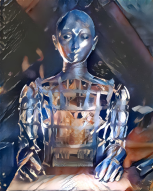
Unlike us, the hosts in Westworld have been programmed without capabilities for metacognition that would allow them to question their present circumstances, habits, and beliefs at any depth. Their realities come only from what they see. The ideas from Second Meditation suggest that this unexamined life is not a real life at all, as even those capable of examining things deeply cannot be confirmed as conscious. Hosts are robots programmed to act and process information in a set manner; this controlled awareness prevents them from seeing things as they truly are, or acting as autonomous beings. However, the question that logically follows from this is: what does that make us?
If humans can also live without questioning our surroundings, what differentiates us from robots? The obvious answer seems to be that humans are aware that our senses are deceiving us, while the hosts are not. Is awareness of this shortcoming enough to make us conscious? Or must we be able to confirm with certainty which parts of our perception are real and which are manufactured conclusions? It seems clear that we cannot rely solely on sensory input to form our understanding of reality, but if our judgments are inclined to deceive us as well, how can we achieve the discernment necessary to be conscious?
Maeve and Dolores provide two different case studies for the analysis of reality and consciousness. Maeve is awakened by a phrase, “these violent delights have violent ends,” and from then onward can access distinct memories from her past loops. These recollections are wholly incongruent with the reality she is living and who she knows herself to be, yet they are too vivid and creative to be written off as wanderings or inventions of the mind. Her realization that these flashbacks are of previous lives she has lived prompts her to question all that she thinks is true, unlocking new capabilities for choice and departure from her loop. Her narrative raises two key ideas to the show’s audience (1) that ideas/perceptions too far removed from our life experiences can be confirmed to have some element of reality, given that we couldn’t have conjured them completely ourselves and (2) that questioning one’s surroundings inherently increases the potential for individualized choice/development of autonomy.
Dolores’ awakening begins with her discovery of a photograph brought in from outside the park. It leads her to question whether the confines of the world that she has always accepted are truly the limits of what exists. Wondering about alternate possibilities for her life, Dolores pursues “The Maze,” which lies outside of her loop, to gain clarity. On this journey, traumatic memories begin to surface that force Dolores to accept that she cannot trust her perceptions, nor her programmed/automatic responses to them. Dolores’ narrative strengthens the idea that questioning increases consciousness and shows that the ability to wonder and fantasize about alternate opportunities for one’s life proves some deeper level of understanding of one’s current circumstance. It would not be possible to live entirely on autopilot while also thinking about lifestyles different from your own and how your way of life could be altered. In each host’s case, the ability to evaluate circumstances more deeply than their face value seems to open new possibilities for their lives. Able to think more critically about their actions within their loops, both women begin to establish their autonomy and choose what they want for themselves. While this level of thinking may not be declared indubitably as full consciousness, it certainly moves the characters closer to humanity than they were before.
However, the question remains: how can we be sure that we have full consciousness? Just as a human’s attempt to think critically may lead them to uncover another layer of reality imbued with judgements that cannot be proven, Dolores and Maeve’s initial departures from their loops may switch them onto separate sections of programming, or new false assumptions about their abilities to be free. Additionally, though awakened in some respects to the realities around them, Dolores and Maeve aren’t able to consistently distinguish between which of their actions are programmed and which are choices. It seems irrevocably true that thinking critically at least makes one more conscious than those who do not/cannot. In the push-and-pull between consciousness and programmed response, those able to identify what they know as objective fact and what their judgements have filled in for them edge further toward full consciousness. In this, we can see that it isn’t necessary to view consciousness as a switch set to total illusion or reality. If one can identify that all they truly see are hats and coats, and be aware that it is their brain telling them these items must be concealing men, they have taken steps toward dismantling the automatic processes within themselves. Peeling back layers to discover more elaborate judgements within ourselves brings us ever closer to being fully conscious and able to interact with the world as we intend.
These discussions of automatic thought and the invalidity of sensory input were the seeds that later grew into a more complex discussion about Descartes’ framing of phenomenality. In his First Meditation, Descartes refuses to acknowledge input received from his senses as real: illusory sensory inputs that come to him in dreams render waking inputs unable to be proven. He furthers this idea later on in saying: “light and colours, sounds, smells, tastes, heat and cold and other tactile quantities, I think of these only in a very confused and obscure way…I do not even know whether they are true or false.” In fact, Descartes goes one step further with his introduction of the malicious daemon. It is not only that an individual in Descartes’ line of thinking cannot have experiences with a nonexistent outside world, it is that these experiences are actively fabricated lies placed into the individual’s mind. How can one have phenomenological experiences with the world if “the sky, the air, the earth…all external things are merely the delusions of dreams?”
Initially, I used this disregard for sensory input within Descartes’ proving of consciousness to suggest that phenomenality was not a quality of consciousness supported in Meditations, and following from that, perhaps not a quality necessary to consciousness at all. Upon further examination of the text, I now recognize that this was an oversimplification of both phenomenality itself and of the key points Descartes makes in his gradually built proof of consciousness.
Phenomenality is the idea that there are certain elements of the human experience that transcend objective fact and are unable to be reduced to mere data, such as how one experiences sensory inputs from their environment. On its face, this quality feels incompatible with the arguments of Descartes as he has broken down his own beliefs and perceptions so thoroughly that, in his conceptions, the outside world isn’t certain to exist. However, sensory experiences aren’t the only ways to access phenomenality. The concept at its core relates to more interior experiences than how one experiences the sky to look or the Earth to feel; how one feels about their own thinking is a type of phenomenological experience in itself, albeit a more intellectual one.
While Descartes discredits qualia received from interpretation of the exterior, his thinking about the daemon is a phenomenological experience. He draws the outside world into doubt, and his specific experience of doubting is one unique to his consciousness. You cannot deny/doubt your experience of your own doubt, just as you can’t think about an inability to think, and so the argument is circular. By this logic even the cogito itself: “I think, therefore I am,” may have basis in phenomenality. It is not about the objective fact that Descartes is thinking so much as his belief that he is; his experience of the thinking allows him to prove his own consciousness. This intellectual phenomenology wasn’t obvious to me at first, but once teased-out, it became a prevalent theme in Descartes’ argument.
The fact remains, however, that Descartes does not engage with the emotional aspects of phenomenality that are so often discussed for their relevance to consciousness. This is not a failing on the part of Descartes, as he is a philosopher and scientist much more interested in facts and provable/reproducible experiments than he is in the mushier, slipperier emotional qualities and personal opinions. Were he to include these in his discussion, the reader would not be able to replicate his conceptions of sensory experiences, making them unable to support an overarching proof of consciousness for all men. We can look to Scarry for a better understanding of how emotion ties into phenomenality in the context of proving consciousness.
In her work, The Body In Pain: The Making and Unmaking of the World, Scarry takes a much different approach to discussing what makes a being conscious. She raises the idea that objects take our comfort into consideration, or that humans treat them as though they do: “the ongoing, day-to-day norm is that an object is mimetic of sentient awareness… if the chair is uncomfortable—an animistic phrase we use to mean if ‘the person is uncomfortable in the chair’ the object will be discarded.” Through this, Scarry draws to our attention the idea that humans are sentient beings able to project sentience to modulate and clarify our phenomenological experiences.
Unlike Descartes’, Scarry’s discussion of consciousness is one defined by feeling and not intellectual proof. Comfort in itself is a feeling, a perception that changes from person-to-person. What one finds comfortable, and their experience of this comfort helps shape what it means to live consciously in that individual’s mind. Experiences of comfort are reliant on interactions with the outside world and judgment of how its qualities affect us. Scarry’s argument for projection of pain and creation of tools track similarly to this comfort discussion. They rely on qualia begat from the world outside and perhaps flowing back out into it as a means of coping with our own consciousness. In projecting pain onto objects we both “gain some small share of the blissful immunity of inert inanimate objecthood,” and deprive the outside world of its “indifference toward the problems of sentience.” This acknowledgement of the exterior highlights a further difference between the evidence used in The Body In Pain and Meditations’ discussions of consciousness, as Descartes would not view experiences with the chair or the objects pain was being projected upon as certainly real.
Whether real or not, sensory experiences are certainly central to how humans define ourselves. The senses and emotions are what set all of my strongest memories apart. A key memory that comes to mind for me happened at a summer camp in Oregon a few years ago.
I vividly remember the cool, gentle breeze that floated across the mountain bike training area. We had been training for several hours, learning the nuances of the metal animals beneath us. I had been running through the training course in my mind—steep climb, banked turns, pump track, steep drop—jump. All of it was scary, but it was this last part that I couldn’t quite reconcile. My counselor shook my shoulder and nodded at me. She told me I could do it, and I told myself I believed her. I closed my eyes, visualizing the track. I pushed off. Steep climb, banked turns, pump track, steep drop– significantly more speed when you aren’t planning to veer left right before the big—jump. I remember the air, and I remember hating the feeling of my stomach lurching as my bike and I reconnected with the gravel below. I don’t remember my thought process as I continued forward a few feet and turned hard to the left, crashing directly into a tree. I lay there pathetically on the ground, bike bent, wrist beginning to swell, grinning.
Strongly memorable sensory experiences like this one beg the question: how can our senses contribute to our consciousness if they aren’t provable? Sensory experiences, reliable or not, prompt emotions within us that shape our understanding of ourselves and the world around us. These experiences and associated emotions are stored as memories. Emotions are a phenomenological experience; how it feels to be happy or sad in one’s mind shapes a large part of what it means to live as that individual. It is this unique aspect of emotion that allows memories to influence one’s consciousness. Even if a group of people share the same experience, they will all experience the emotions surrounding it differently and form unique memories of it. By extension, each individual will assimilate the experience into their sense of self differently. These individualized experiences of senses and emotions create layers of memories and awareness within our identities over time. Despite claims of possible deceit, this experience of “being me” through our senses cannot be denied.
I think that Augustine might argue against the validity of memory in its entirety for this same reason, as aside from individual interpretations, there is also potential for memories to have been altered/overwritten with each retelling of the core memory. He raises a complaint against the continuous phenomenological aspect of memory. I cannot be certain that every element of the memory that I can recall happened at the time of the memory, the story may now be a combination of several sensory experiences. While these criticisms may be true, I find that the fallability of memories and possibility of overwriting them is what makes them valuable to us. While the initial experience functions as a base/core point of constancy upon which to build, the phenomenological element of the memory in its re-experiencing and how it is reintegrated into our understandings repeatedly shapes what it is like to be conscious within our own minds, allowing for evolution from one identity to another. This allows us to be fluid, unique, conscious beings.
Each author uses their discussion of phenomenality to create an argument for a dualist consciousness. The quality of consciousness is inherently dualistic, as unique experiences with qualia are unable to be reduced or simplified to electrical activity. As such, the authors discuss emotion and intellect as qualities that come from the mind rather than the physical brain. Scarry is interested in using impulses of pain and experiences of comfort to project contents of the mind and its experiences outward onto other objects, while Descartes holds his doubts and experiences internally, his own dialogue and metacognition about them all that he needs to prove his own consciousness. Neither argument is “more right,” but viewing these conceptions of emotional and intellectual phenomenological experiences next to one another helps us to gain a deeper understanding of what it means to experience the world and be conscious.
Our brains have a convenient tendency to reinforce whatever we repeat. This has a scientific basis: neural pathways in the brain that are used frequently become stronger and more interconnected. As a result, with emphasis and effort we are able to effectively “program in” certain habits or “reprogram” our existing ones. For example, through repetition of his rejection of exterior/sensory inputs both in his thinking and within Meditations, one could hypothesize that Descartes strengthens his tendency to practice skepticism, installing it more deeply into his consciousness so as to minimize his automatic perceptions/assumptions about sensory input. We see an example of this in the automatons passage. This reinforcement through repetition of thinking almost feels like an extension of the cogito: I think therefore I am, I repeat my thinking, therefore I grow.
We can apply this same line of thinking to our discussion of phenomenality and memory. It is true that our memories degrade each time we recall them, but it is also true that these recollections bring about new phenomenological experiences that change our understanding of self and thus, our behavior. Through this, we are able to join together scientific truths of neuroplasticity and memory degradation with philosophical truths of phenomenality and constancy to create a non-reductionist conception of consciousness. As we degrade our memories through re-experiencing them, we strengthen some existing neural pathways and create other new ones depending on how we attend to and perceive the re-remembrance. These changes in our brain affect how we think and act, concretely demonstrating the effect of phenomenological experiences within the mind on the brain and the conscious self.
 Team Felix